Engineered Hardwood vs Solid Hardwood: What’s Right for Your Home

engineered hardwood vs solid hardwood

Most folks think hardwood is just hardwood – but it isn’t. We’ve worked with both for years, and trust me – solid hardwood and engineered hardwood might start from the same log, but they live totally different lives. One’s a single piece of lumber that swells and shrinks with every season; the other’s a layered plank built to resist those changes.

Solid hardwood is cut straight from oak, maple, or hickory – thick, sturdy, and ready to be sanded five or six times over its lifetime. Engineered hardwood has a real-wood veneer on top of plywood layers that keep it flat and calm when humidity rises. So while solid hardwood gives you decades of refinishing potential and that deep, solid-oak thud underfoot, engineered hardwood delivers better dimensional stability, moisture control, and easier installation.

In simple terms: solid wood is about longevity and character; engineered wood is about practicality and performance. The choice usually comes down to where it’s going – dry spaces versus basements, radiant-heat systems versus old-school subfloors, budget versus refinishing freedom.

At 1 DAY® Refinishing, our crews deal with both every week. We’ve restored century-old oak that still shines after seven sandings and laid engineered planks that laugh off damp slabs. If you’re trying to figure out which one fits your home best, let’s break it down the same way we do on site: structure, stability, lifespan, and how each really behaves once it’s under your feet.

Solid Hardwood Flooring – Traditional Strength, Timeless Feel

Structure and Composition

Solid hardwood is pure wood – one solid piece, milled from top to bottom. No fancy cores, no glue layers. That’s why it gives that deep thud when you walk barefoot across oak or maple. It’s usually around three-quarters of an inch thick, and you can feel the weight of it.

Because it’s one solid mass, it expands and contracts with the seasons. That’s normal – wood breathes, same as us. We always let it sit on-site for a few days before nailing it down so it can adjust to the room’s air. Keep the temperature and humidity steady, and you’ll avoid most of the gaps or cupping that show up later. Simple, but worth repeating.

Lifespan and Refinishing Potential

Here’s where solid wood really earns respect. The wear layer is the whole board, so you can sand and refinish it several times before running out of material. Industry experts from Hardwood Floors Magazine – the official publication of the National Wood Flooring Association – note that most solid hardwood floors can be sanded and refinished five to seven times over their lifespan, depending on thickness and condition.

I’ve personally restored oak floors installed nearly a century ago – the kind still found in older homes with thick quarter-sawn boards. Each sanding only removes about a thirty-second of an inch – just enough to expose fresh grain and color. Treat it right – sweep the grit, keep humidity stable, and recoat every few years – and you’re looking at 75 to 100 years of service. Floors like that outlive furniture, paint, and sometimes the house itself.

Ideal Room Placements and Humidity Limits

Solid wood likes comfort zones – living rooms, bedrooms, upstairs halls. It doesn’t get along with basements or damp kitchens. Too much moisture and it swells; too dry and it cracks. Think of it like an old friend who hates sudden weather changes.

Engineered Hardwood Flooring – Modern Stability and Flexibility

Layered Construction and Materials

Engineered hardwood was built to calm wood’s wild side. It’s a sandwich – a real hardwood wear layer on top, a cross-laminated plywood or HDF core below, and sometimes a balancing layer underneath. Those alternating grains keep it steady when humidity swings.

That top veneer might be red oak with warm honey tones, hickory with rustic streaks, walnut for deep chocolate browns, or maple if you like a clean, light look. The core’s often birch or poplar bonded with low-VOC adhesives – glues designed to release fewer volatile organic compounds into the air. According to the EPA, VOCs are gases that can come from certain building materials and finishes, so using low-VOC options keeps indoor air cleaner and safer once the floors are installed. Still wood – just smarter wood.

How to Clean Engineered Wood Floors

Advantages in Moisture-Prone Environments

Because the layers pull against each other, engineered flooring doesn’t cup or warp like solid. That’s why we use it in basements, kitchens, or over radiant heat. When we install on concrete, we always lay a vapor barrier – the NWFA recommends moisture differences under 4 percent between slab and plank.

And installation? Plenty of options. Some planks click together and float; others get glued or stapled. We choose by room conditions, not marketing claims.

Veneer Thickness and Refinishing Limits

Here’s the catch – veneer thickness decides how many lives that floor has:

  • 0.6 mm = a quick buff and coat only
  • 2 mm = one full sanding
  • 4–6 mm = two to three refinishes – almost like solid performance

I always tell clients: pay a little more for thicker veneer. You’ll thank yourself twenty years from now when a light sanding brings it right back.

Comparing Solid vs Engineered Hardwood

Durability and Dimensional Stability

Durability isn’t just a number – though for reference, hickory hits about 1,820 lbf and red oak roughly 1,290 lbf on the Janka hardness scale. Those numbers come from testing by the U.S. Forest Products Laboratory , a federal research center that studies how different woods respond to force, wear, and long-term use. The Janka test they publish measures the pressure needed to press a small steel ball halfway into a wood sample – basically a scientific way to show how tough each species really is. That data gives refinishers and installers a solid benchmark when judging how a floor will handle dents, furniture legs, and years of traffic.

Still, numbers only tell part of the story. What matters is how the floor behaves day to day. Solid oak takes heavier dents and keeps that old-school density underfoot, while engineered stays flatter through winter and summer. When the air swings from dry to damp, engineered just rides it out with less movement and fewer gaps. If you’re comparing species, our piece on the hardwood hardness scale shows what those numbers actually feel like once the floors are under your feet.

Key steps in hardwood floor installation

Cost, Installation, and Long-Term Maintenance

Cost changes more with method than material. Nail-down solid needs a wood subfloor and extra labor; click-lock engineered goes down fast. On average, solid runs $10–$15 per square foot installed, while engineered averages $8–$13.

Maintenance is about the same – vacuum regularly, control humidity, and skip the wet mops. Refinishing is where solid still wins: it just has more wood to work with.

Feature Solid Hardwood Engineered Hardwood
Core Structure Single solid wood Multi-layer plywood / HDF core
Refinishing Potential 5–7 times 1–3 times (depends on wear layer)
Moisture Resistance Low – needs stable humidity High – cross-laminated core resists cupping
Installation Options Nail / Staple only Nail / Glue / Float
Average Cost (Installed) $10–$15 / ft² $8–$13 / ft²
Ideal Rooms Living areas, bedrooms Basements, kitchens, condos

Comfort, Sound, and Thermal Performance

Solid floors feel heavier – that deep, confident knock when your heel hits oak. Engineered can sound a little hollow if it’s floating, though a good cork or foam underlayment helps soften the echo. Over radiant heat, engineered spreads warmth evenly; solid sometimes dries out along the seams if humidity isn’t kept steady.

Environmental and Resale Considerations

Engineered flooring uses less hardwood per square foot, which helps conserve lumber. Many quality lines carry FSC or CARB 2 certifications for sustainable sourcing and low emissions.

For resale value, both make a strong impression – most buyers just want “real wood,” and both qualify. If you’re planning a remodel for long-term value, check out our guide on how hardwood floors increase home value to see how homeowners typically gain after installation or refinishing.

Choosing the Right Type for Each Room

Every room has its own personality – some humid, some quiet, some full of traffic. Here’s how we usually guide homeowners:

Room Recommended Type Notes from the Field (Wood Species & Tone)
Living Room / Dining Area Solid or Engineered Red oak or hickory – warm mid-tones, both perform well; engineered handles radiant heat better
Bedrooms Solid Hardwood Maple or walnut – smooth grain, cozy palette, low moisture risk
Kitchens Engineered White oak or birch – neutral hues, handles spills and humidity swings better
Basements / Lower Levels Engineered only Ash or hickory – tough grain, glued or floated over slab with vapor barrier
Hallways / Entryways Solid or Thick Engineered Hickory or cherry – hard surface, darker tones hide wear
  • Living Room / Dining Areas
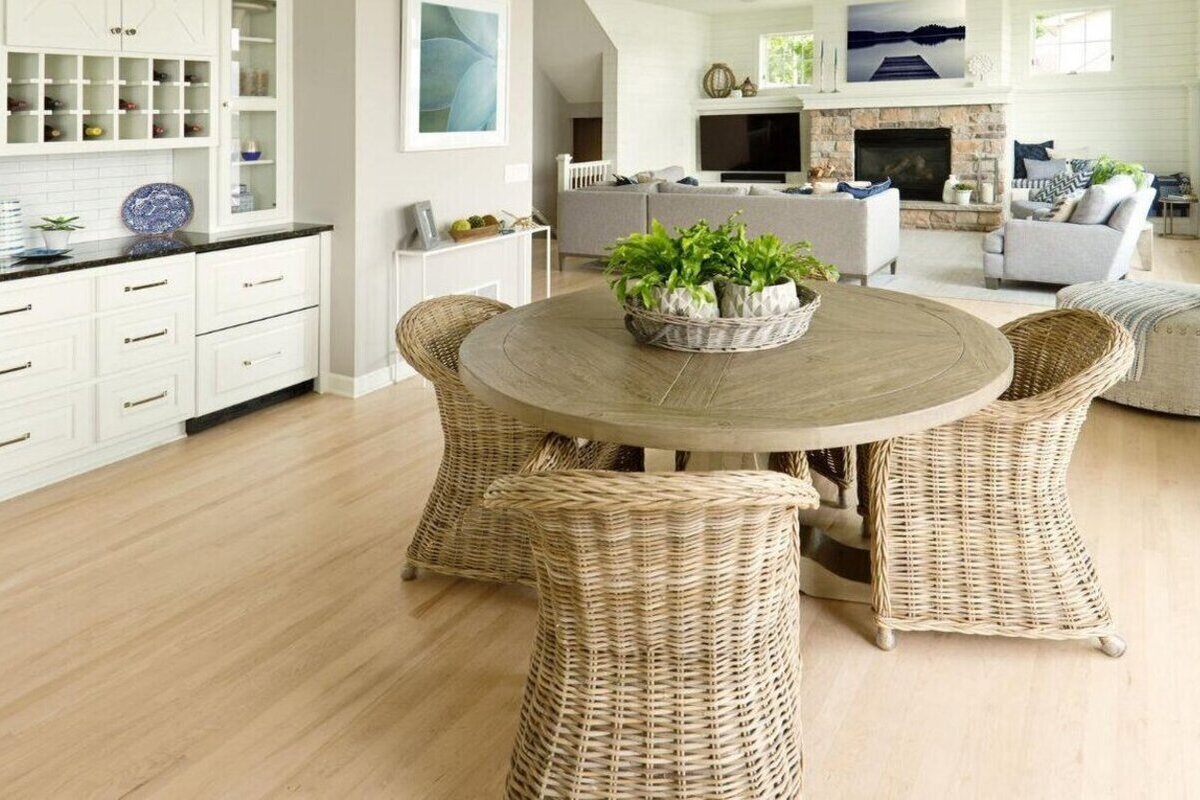
    These rooms stay steady through the seasons, so either flooring works. Solid oak brings that deep, classic feel, while engineered fits perfectly over radiant-heat systems and handles temperature shifts with less fuss.
  • Bedrooms
    Quiet, dry, and comfortable – solid wood feels right at home here. It softens sound and can be refinished decades later without losing character. Keep the air balanced, and it’ll look just as good after twenty years of footsteps.
  • Kitchens and Bathrooms
    Moisture’s the wild card. Engineered flooring performs better in kitchens when glued tight and seams are sealed with a durable high-traffic hardwood floor finish . Bathrooms are trickier – a small powder room might handle engineered if ventilation is solid, but full baths with daily moisture aren’t worth the risk.
  • Basements and Lower Levels
    That one’s easy – engineered only. Solid wood doesn’t play well with concrete or humidity swings. A floating engineered setup lets the slab breathe and keeps the surface flat season after season.
How to clean old hardwood floors

Maintenance, Refinishing, and Longevity

Keeping hardwood floors looking their best is about timing, care, and knowing the limits of each type.

How Refinishing Cycles Differ

Solid floors can usually take a deep sanding every 15–20 years – plenty of time between makeovers. Engineered floors depend on the veneer thickness: some can handle one full sanding, others maybe two or three before the top layer runs thin. Before any hardwood floor refinishing job, we always check the wear layer first to see what’s safe to sand.

Thin veneers – anything under 2 mm – get a light screen and recoat rather than a full cut. That quick touch-up adds another five to seven years of life without risk. And keeping dust from sanding hardwood floors under control is part of the craft – proper vacuum systems and sealed containment keep the air clear and prevent the fine haze most folks still expect from old-school sanding.

Cleaning, Humidity Control, and Finish Upkeep

  • Clean: Use a microfiber mop or soft-brush vacuum.
  • Skip: Steam mops or soaking wet cloths, which damage the finish.
  • Humidity: Keep levels around 35–55%. Use a humidifier in winter and a dehumidifier in summer if needed.
  • Recoat: Apply every 3–5 years with waterborne polyurethane for optimal longevity.

Factory aluminum-oxide finishes last longest but are tougher to sand later. Waterborne finishes dry faster and have lower odor. Choose the finish based on what matters most to you – long-lasting durability or easy maintenance.
Hardwood floors sanding, staining, refinishing contractor in Inwood, NY

Professional Refinishing Advice from 1 DAY® Refinishing

Our pros use dust-contained sanding with HEPA vacs – no fog of sawdust over your couch, no haze drifting through the hallway. You can breathe easy while we work – that’s what true HEPA filtration is built for.

According to the EPA, certified HEPA filters capture 99.97 percent of airborne particles as small as 0.3 microns, keeping fine wood dust out of the air and off your furniture. It’s the same standard used in hospitals and labs, which makes a big difference when we’re sanding inside someone’s home.

For solid floors, we start coarse – 36-grit – then move through 60, 80, and 100 before buffing and coating. Each pass levels the surface while the HEPA vac stays locked on, pulling away every bit of fine dust. Engineered floors? We baby them – usually a 120-grit screen only – because once you cut through that veneer, it’s game over.

And don’t wait until boards turn gray or black. Once stains dive deep, sanding might not save them. Catch wear early – a light recoat’s way cheaper than a rescue job.

If you’re unsure which type you have, contact 1 DAY® Refinishing . We’ll check veneer thickness and tell you straight – refinish, recoat, or replace. Our crews handle all of it with clean air and clean results from start to finish.

Finding What Fits Your Home’s Rhythm

So … which one’s better? Honestly, it depends on your house – and you. Want that heritage feel and the freedom to refinish again and again? Solid’s your pick. Need stability through every humidity swing or radiant-heat setup? Engineered’s got your back. Both can look incredible. Both last decades if you treat them right. The real trick is matching the floor’s personality to your home’s rhythm.

At 1 DAY® Refinishing, we’ve helped homeowners make that call for years – sometimes bringing century-old oak back to life through careful hardwood floor refinishing , sometimes giving new engineered floors a tone and finish that fit the space just right. A lot of folks think refinishing’s just sanding and coating, but we like to say, “It’s more like giving the wood a reset – letting it breathe again.”

Whether it’s a solid oak revival or an engineered refresh, we’ll help your floors look and feel right for the life you live.

Hardwood Flooring Guide: Find Your Perfect Match

Types of Hardwood Floors - Red Oak

Every hardwood floor has its own rhythm – you can almost hear it. Oak gives that steady creak, maple feels smooth and cool underfoot, hickory sounds firm and grounded, and cherry glows when sunlight hits just right. Our crews at 1 DAY® Refinishing catch those details every day while sanding, polishing, and bringing worn floors back to life. Homeowners often ask: “Which kind of hardwood should I choose for my home?”

Well, it starts with the type of floor itself. Solid hardwood lasts for generations and can be refinished many times. Engineered wood offers more stability in homes with changing humidity, while reclaimed and exotic woods – like old oak beams or deep-red mahogany – bring one-of-a-kind character.

Then come the species. Woods such as oak, maple, and hickory stand up to heavy traffic and multiple sanding cycles, while walnut, cherry, and pine add warmth, color, and a softer, more natural feel. Each species carries its own grain, tone, and scent once it’s sanded clean.

And finally, there’s the finish – the surface layer that changes both how a floor looks and how it feels beneath your feet. From low-sheen matte that hides dust to high-gloss coatings that reflect light across the room, the right finish ties the whole space together.

Let’s get into what makes each kind of hardwood special – and how to pick one that fits your home’s rhythm.

Main Types of Hardwood Flooring

1. Solid Hardwood Flooring – The Timeless Classic

Solid hardwood is exactly what it sounds like – a single, thick plank milled from solid wood. You can sand and refinish it again and again, which is why our crews at 1 DAY® Refinishing often restore 30- or 40-year-old oak floors that still have plenty of life left in them. It feels firm and natural underfoot, with that unmistakable warmth only real wood gives. Solid hardwood performs best when installed on or above ground level, in areas where humidity stays moderate and stable throughout the year.

Refinishing potential: typically 5 to 10 full sanding cycles over its lifetime, depending on board thickness.

Key traits: nailed directly to the subfloor, incredibly long-lived when humidity is controlled, and ideal for homeowners who want floors that can be renewed for decades rather than replaced.

2. Engineered Hardwood Flooring – Stable, Smart, and Versatile

Engineered hardwood combines a real hardwood veneer with a layered plywood or HDF core. That structure keeps it from expanding or contracting as much as solid wood, which helps in homes that see seasonal humidity swings. It still refinishes beautifully – our pros just sand lightly to protect the thinner wear layer. You’ll find it in basements, kitchens, and open living spaces, where moisture control matters more than depth of wood.

Refinishing potential: usually 1 to 3 professional sanding cycles, depending on veneer thickness (most quality boards average 3–5 mm of wear layer).

Key traits: dimensionally stable, compatible with radiant-heat systems, and a practical choice when solid planks aren’t ideal.

3. Reclaimed and Exotic Hardwood Floors – Personality in Every Board

Some hardwoods already carry a lifetime of stories. Reclaimed boards from barns, mills, or old homes show knots, nail marks, and deep patina that no factory finish can copy. When sanded, they release that warm, earthy scent of aged timber – something our crews always notice on restoration jobs. Exotic woods such as Brazilian cherry, tigerwood, and mahogany bring dense grain, rich color, and exceptional hardness (often 1,800–2,800 on the Janka scale). They can challenge sanding belts but reward patience with mirror-smooth results.

Refinishing potential: typically 2 to 5 cycles for reclaimed boards (depending on previous wear) and 3 to 6 for most exotics.

Key traits: high visual impact, excellent longevity, and – when sourced as FSC-certified reclaimed wood – a sustainable way to add character and history to modern homes.

Kitchen design ideas with hardwood floors in a modern kitchen

Matching Hardwood Floors to Room Types

Before picking a species, think about how each room lives. Kitchens breathe heat and moisture; hallways take hits from shoes and grit; bedrooms need quiet comfort underfoot. Over the years, our crews at 1 DAY® Refinishing have seen the same pattern – certain woods just work better in certain spaces. The table below blends real homeowner feedback with what we’ve learned sanding and restoring floors day in, day out.

Room Type Recommended Hardwood Notes from the Field
Living / Dining Solid Oak, Walnut, Cherry Timeless look, easy to refinish multiple times, handles light wear beautifully.
Bedroom Maple, Birch, Pine Warm, soft underfoot; quieter feel when walking barefoot; gentle sanding keeps them glowing.
Kitchen – Moisture and Heat Challenges Engineered Oak or Hickory Stable in changing humidity; holds finish well if sealed edges and water-resistant topcoats are used.
Bathroom / Powder Room – Use with Care Engineered hardwood with sealed joints Needs strong ventilation, sealed perimeters, and regular checks for moisture buildup – always follow humidity guidelines for wood flooring to keep edges tight and finishes stable.
Basement – Below Grade Engineered Oak or Hickory Designed for glue-down setups; resists seasonal expansion and refinishes cleanly if the veneer’s thick enough.
Hallway / Entry – High Traffic Zones Hickory, White Oak Hard, durable surfaces built for shoes, pets, and constant motion; refinish every 10–15 years for best wear.

Most research we’ve seen – including findings from the National Wood Flooring Association (NWFA) on moisture and wood performance – confirms what we find in the field: stable humidity and proper finish selection extend a floor’s life more than any coating alone. The science just backs up what experience already shows.

When you’re comparing, picture how the floor feels and sounds. Oak carries a confident step; walnut gives a soft thud; pine hushes a room. Those tiny details – the warmth, the echo, the way light hits the grain – often decide what feels right for your home more than any spec sheet ever could.

Ash wood flooring installed in a bright room

Choosing the Right Hardwood – Expert Advice

Here’s what our team usually tells homeowners before they decide which hardwood fits their home and lifestyle:

  1. Think Refinishing Before Replacing.
    A solid oak or maple floor can handle five, six–sometimes even ten–complete sandings in its lifetime. Engineered floors allow one or two careful refinishes, depending on veneer thickness. Keeping what you have and renewing it when needed usually brings better long-term value than starting from scratch.
  2. Don’t Overlook Softer Woods.
    Cherry and pine may dent, but refinishing blends those marks into the grain and gives them depth. Some of the most beautiful floors we’ve restored were full of character – small scratches, subtle color shifts, the kind of wear that feels lived-in, not worn-out.
  3. Match the Finish to How You Live.
    Matte hides dust, satin brings a soft glow, and gloss bounces light across a room. During refinishing, we often test a few finish options so homeowners can see how sheen affects both look and feel before committing. For homes with kids, pets, or busy hallways, it’s worth learning more about finishes for high-traffic hardwood floors that hold up under everyday wear.
  4. Keep an Eye on Humidity.
    Wood breathes – it expands and contracts with the seasons. A simple home hygrometer helps. Stay within 35–55% RH, and your floors will stay flat, smooth, and ready for the next refinish when the time comes.
  5. Plan for Upkeep, Not Perfection.
    Hardwood floors age gracefully if you let them. A light buff and coat every few years preserves the surface, while full sanding resets it completely. Perfection doesn’t last long – but well-finished wood only gets better after every refinishing cycle.

Finish Options and Sheen Levels

A finish doesn’t just seal wood – it decides how that floor lives day to day. The right sheen changes how light moves across the room, how your shoes sound on the boards, even how warm the surface feels under bare feet. After years of restoring every kind of floor imaginable, our crews at 1 DAY® Refinishing know exactly how each finish behaves once it’s lived in:

Finish Type Sheen Level Best Rooms Notes from the Field
Oil-Based Polyurethane Semi-Gloss / Gloss Dining & formal areas Warm tone, slower cure, deepens color beautifully.
Water-Based Polyurethane Matte / Satin Bedrooms, kitchens Low-VOC, fast-dry, stays clear without yellowing.
UV-Cured Factory Finish Satin / Semi-Gloss Prefinished floors Hard, odor-free surface ready to walk on.
Hard-Wax Oil Matte Living rooms & hallways Natural texture, easy spot repair, soft underfoot.
Aluminum Oxide Coating Low Satin High-traffic zones Toughest surface; harder to sand later.

Each finish changes more than shine. Oil-based feels rich and warm; water-based keeps the room cooler and lighter. Go semi-gloss if you like a floor that “talks” a little when you walk, or matte if you want quiet comfort. And remember – finish choice also shapes how long you’ll wait before that next refinish.

Hardwood flooring around a fireplace in a living room

Maintenance Tips by Wood Type

Good floors age well when they’re cared for, not pampered. Maintenance is simple, but rhythm matters: light weekly cleaning, seasonal checks, and a full refresh before the finish wears thin. Here’s what usually works best:

  • Oak / Hickory – Vacuum once a week, damp-mop monthly with a neutral-pH cleaner, and recoat every 5–7 years. Heavy-use homes might need a quick buff-and-coat between full refinishes closer to every 3 years.
  • Maple / Birch – Skip harsh or ammonia cleaners – they cloud the finish. Wipe spills fast, keep felt pads under furniture, and plan for a recoat every 5 years or so.
  • Walnut / Cherry – Dry-mop two or three times a week; darker tones show every footprint. A light topcoat every 6–8 years keeps color deep and surface smooth.
  • Pine – Softer, sure, but forgiving. Clean with a barely damp mop, and schedule a light sanding and recoat every 8–10 years to even out wear.
  • Engineered Hardwood – Stick to dry-mopping; moisture sneaks into seams fast. Keep humidity steady between 35 and 55 percent year-round to prevent cupping.

Use cleaners made for polyurethane or hard-wax finishes – nothing oily, soapy, or acidic. Avoid soaking the floor; a little moisture goes a long way. The goal isn’t mirror shine, it’s balance – keeping that finish flexible so refinishing stays years away.

When scratches start stacking up or the surface dulls, that’s when 1 DAY® Refinishing steps in. Our crews handle sanding, staining, and sealing – usually in about a day – so the floor you already love comes back brighter, smoother, stronger.

Floors That Feel Like Home

Hardwood breathes with a house – warming in sunlight, cooling after dark, holding memories in every mark. Picking the right type isn’t about trends or gloss; it’s about the rhythm of your rooms and how the wood lives with you. From solid oak to modern engineered boards, we’ve seen every kind of floor come alive again after a careful refinish.

When your floors start looking tired, just reach out to 1 DAY® Refinishing for a free quote. We’ll bring back the color, smoothness, and warmth you fell in love with – dust-controlled sanding, durable finishes, and a crew that treats every board like it’s their own.

And honestly, if you’re standing there debating oak versus maple, you’re already close. The best hardwood isn’t the hardest or the glossiest – it’s the one that feels right under your feet every single day.

How Pros Fix Holes in Hardwood Floors Without Replacing Boards

Holes In Hardwood Floors

Hardwood floors carry their stories in every step – the creaks, the dull patches, that one board that catches the light differently than the rest. Over the years, life leaves its mark, and sanding is how we start rewriting those stories. At 1 DAY® Refinishing, our crews know that hum of a drum sander when it’s tuned just right – that low, steady buzz that tells you the grit’s biting clean. It’s not about fancy tools; it’s about rhythm, patience, and the kind of skill that only comes from doing this work day after day.

Before any machine starts, we inspect and prep. Furniture moves out, vents get sealed, airflow’s balanced, and lights drop low so every scratch shows before the first pass. Using drum, edge, and orbital sanders with HEPA vacuums, our crews move through a four-stage grit sequence, blending edges and corners until the floor feels seamless. A full sanding cycle takes about a day per room – maybe two if the boards are uneven – and we clean between every pass to keep the air clear and the wood breathing right.

This quick overview is just the start. What follows is the full walk-through – the process we’ve refined over years, the one that turns long workdays into floors that look new again by the time morning light hits them.

Inspecting the Floor

Before any machine rolls in, we spend time reading the floor. Every board has history. First thing – we check the wear layer. Older hardwoods can be paper-thin, and one heavy pass can take them out for good. We set every nail head down flush; one proud nail can tear a sanding belt in seconds.

Different woods, different behavior. Maple’s tough and slow, oak’s smooth, and pine... well, pine dents if you breathe wrong. If we see cupping or uneven spots, that usually points to moisture or movement underneath. Happens a lot after wet seasons. We’ve got a full piece on how to draw moisture out of wood floors if you want to see how we deal with that.

We run a hand across the grain – feeling for wax, ripples, or grit. A quick water drop tells the rest: if it beads, there’s old finish to remove. If it soaks in, that surface is ready. That tiny check saves hours later.

Tools and Materials You’ll Need

We never start a repair until everything’s staged. Once filler starts curing, you can’t stop mid-fix to find a knife.

Category Examples Purpose
Fillers Wood filler, epoxy filler Core materials for patching
Application Tools Putty knife, plastic spreader, mixing stick Press and level filler
Sanding Tools Sandpaper (120–220 grit), orbital sander Smooth and blend repairs
Cleaning Gear Vacuum, tack cloth, microfiber cloth Remove dust and residue
Safety Items Gloves, respirator, eyewear Protection from dust & fumes
Finishing Tools Stain brush, stain pen, painter’s tape Apply stain or finish coat

Our refinishers always prep the surface with a vacuum and tack cloth. Even a trace of fine dust can block adhesion, so cleaning isn’t optional – it’s part of our repair rhythm.

Assessing the Damage – Small vs Large Holes

Assessment drives the whole fix. We start by checking size, depth, and firmness around the damaged area – a repair only holds if the base wood does.

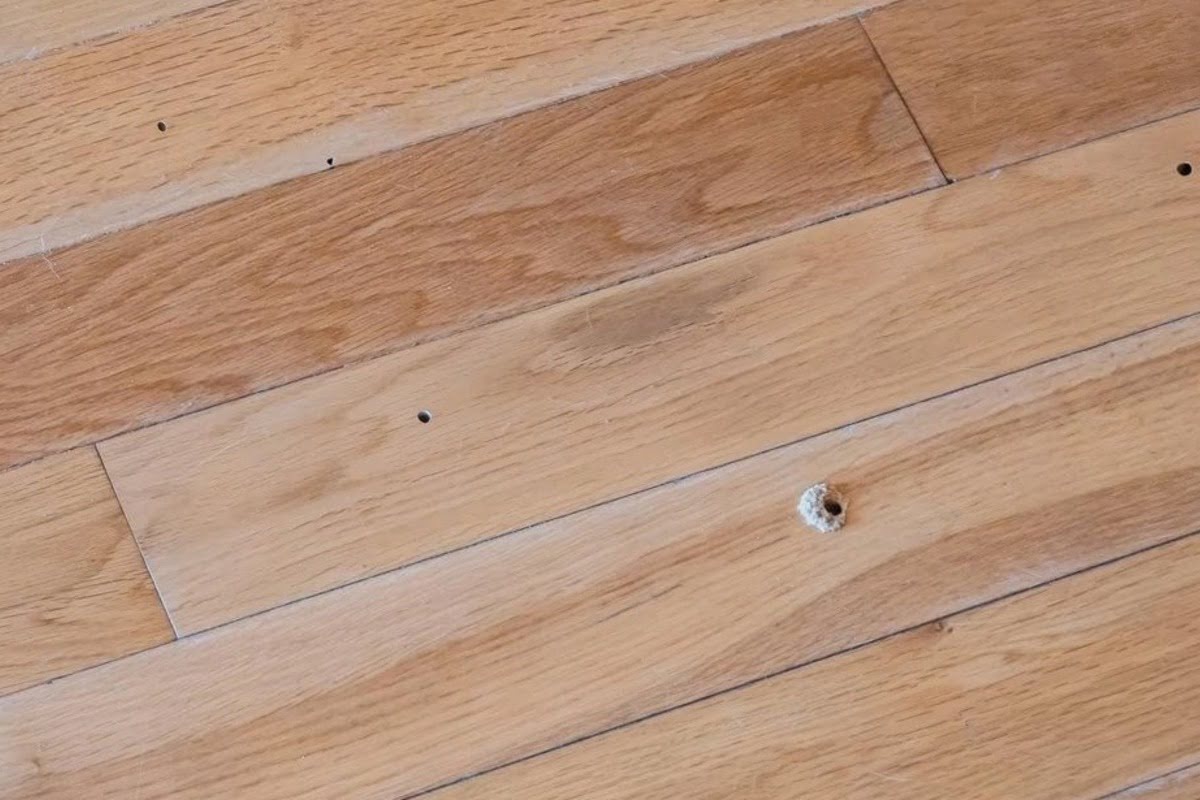
  • Small (< ¼ in.) – these are your surface marks: nail pulls, pet claws, screw holes. They rarely reach the core, so a quick pass with fine-grain wood filler and light sanding usually does the trick. Still, matching the color matters – a poor tone match stands out more than the hole ever did.
  • Medium (¼–½ in.) – dents or cracks that sit just deep enough to catch dirt or moisture. Here we use thicker filler or a two-layer approach, pressing the first coat in tight with a putty knife before topping it once it firms up. A flexible filler works best – it moves a bit with seasonal expansion.
  • Large (> ½ in.) – gaps, missing chunks, or rot that weaken the board itself. These need structure, not just filler. We mix epoxy or cut in a new patch piece so the surface can handle weight again. When epoxy warms slightly in your hands, you know the bond is live – that’s our cue to spread and shape it.

We always probe the edges for softness. If the knife sinks or the wood feels spongy, that’s punky wood – decayed, weakened fibers that can’t hold a patch. In that case, it’s time for a full board replacement, not a quick filler repair.

Technician fixing small holes in hardwood floors

Preparing the Area

Prep defines the quality of the repair – and we treat it like a foundation. Nothing bonds to dirt or wax. Our crew vacuums every groove, wipes with a damp cloth, then runs a hand across the grain. When it feels clean and slightly cool, we know it’s ready.

Moisture levels matter. Anything above 12 % means pause the job and dry it down. We use the same airflow and heat control methods described in our guide on drawing moisture out of wood floors – steady air, gentle heat, patience. A quick pass with a heat gun helps when deep cavities need drying, but we never scorch.

Once the area’s ready, we mask edges with painter’s tape to keep finish lines sharp. It’s like setting the stage before the actors arrive.

Choosing and Applying the Right Filler

The product has to match the problem – and after years on job sites, we’ve tried just about all of them. For small nail holes or surface scratches, we often reach for Timbermate® wood filler – spreads smooth, dries fast, and you can re-wet it if needed. It sands clean and tints easily, perfect for dustless refinishing work.

When the job calls for full-trowel coverage before the final sanding, Bona® Pacific Filler is our go-to. It glides across the surface, stays flexible, and accepts stain evenly – pairs great with water-based finishes like Bona Traffic HD.

Process of patching a damaged wood floor with filler

For deeper structural gaps or cracks that need real strength, Bona DriFast® Epoxy Filler or DuraSeal® Patch & Fill get the call. They’re tougher to sand but bond tight and cure rock-solid. And when we’re restoring large, open floors, Woodwise® Full-Trowel Filler helps close seams fast and blends beautifully across mixed grain patterns.

Each product has its rhythm – water-based fillers dry quick, epoxies build muscle, and oil-based putties still shine on vintage floors. The trick is matching chemistry to the condition of the wood. That’s what separates a fix that disappears from one that stands out under morning light.

Filler Type Best For Durability Sanding Ease Color Options
Water-based filler (e.g., Bona® Pacific, Timbermate®) Small-to-medium holes Medium Easy Broad tone range
Latex / full-trowel filler (e.g., Woodwise®) Large surface seams High Medium Matches most species
Oil-based putty (e.g., DuraSeal® Putty) Shallow imperfections Low Easy Matches finished floors
Epoxy filler (e.g., Bona DriFast® Epoxy) Deep voids and cracks High Harder Tintable
Wax filler stick Hairline marks Low No sanding required Excellent blend

When we’re working a big repair, the mix smells faintly like resin and feels warm in the hand – that’s how you know it’s curing right. You press it in, let it set, and sand until your fingertips can’t find the flaw. That’s the moment when the floor feels whole again.

Fixing Small and Big Holes – Step by Step

Every fix follows the same rhythm – clean base, solid repair, smooth finish – but the scale changes how we work.

Small Holes

We aim for finesse over force. Once the base is clean and dry, we press filler at a 45-degree angle so it grabs the grain. Slightly overfill – it’ll settle as it cures. Most small fixes dry in 30 to 60 minutes, but we always give them a bit longer before sanding; rushing is how you end up redoing it. When it’s ready, we sand with 180–220 grit, moving gently with the grain until the surface feels even. You can feel it change under your fingertips – that smooth, cool shift when the wood feels whole again. A quick wipe with a tack cloth finishes it off, ready for staining hardwood floors or sealing.

Big Holes

Deep voids take structure – and time. Strength comes from layering and patience. We mix epoxy until it warms slightly in our hands – that’s how we know the bond is live. We fill the cavity halfway, let it firm for a few hours, then add a second layer flush with the surface. While it’s still pliable, we level it with a spreader so sanding goes easier later. Full cure usually takes about 24 hours, depending on temperature and humidity.

Once cured, we feather-sand edges with an orbital sander until the patch feels dense and solid under the palm – quiet, no flex, no give. We often tint epoxy before applying – makes blending seamless later, especially on open-grain oak.

Professional wood floor restorer repairing and sanding hardwood floor

Sanding, Blending & Finishing

Sanding too soon tears the patch wide open; wait too long, and it’s like grinding stone. Timing’s everything. We usually start around 120 grit to knock the surface level, then move to 180 or 220 grit for finishing—always with the grain. You can hear the difference when it’s right: the rasp turns into a soft hiss, and the floor almost hums under the sander.

Once the filler feels firm—usually four to six hours for water-based or up to twenty-four for epoxy—we wipe everything down with a tack cloth until the surface feels chalk-smooth. Fine dust may look harmless, but it lingers in the air and can ruin a coat fast. According to the EPA Indoor Air Quality Design Tools for Schools , keeping airborne particles under control during renovation cuts exposure risks dramatically. That’s why our crews always vacuum between grits and tack before any finish hits the wood.

Then comes the seal. We match whatever system’s already on the floor—Bona Traffic HD, Loba 2K Supra, or Minwax Super Fast-Drying Poly if it’s an oil-based setup. Water-based dries fast and clear; oil gives that warm amber glow; hardwax oil leaves a natural feel underfoot. Each has its rhythm—some need a light screen between coats, others just a clean wipe and re-coat window.

Filler Type Touch-Dry Full Cure
Water-based filler 30–60 min 4–6 hr
Epoxy filler 2–4 hr 24–48 hr
Oil-based putty 15–30 min 2–3 hr
Floor patch compound ≈ 1 hr 8–12 hr

Cool basements can double those numbers; warm, ventilated rooms cut them in half. Different species take stain their own way—oak deepens quick, maple hardly shifts—so we always test before committing to a final coat. When that sheen levels out and the boards reflect clean light end-to-end, that’s the moment we know the repair’s invisible.

Hardwood floor staining after filler repairs and sanding

Common Mistakes and Pro Practices

After years in the trade, we’ve seen plenty of DIY fixes go sideways – one small miss with filler or timing, and suddenly the whole board needs replacing.

That’s why our crews at 1 DAY® Refinishing follow a tighter process from start to finish. Here’s the checklist our team works by – the small things that keep repairs clean, tight, and built to last:

  1. Clean first, always. Even a speck of dust kills adhesion faster than bad filler — that’s why we follow the same dust-control steps used when sanding hardwood floors.
  2. Overfill slightly. Every filler shrinks as it cures – better to shave it down smooth than chase a dip later.
  3. Let it cure fully. Surface-dry doesn’t mean bonded. We always give the mix the time it needs – a few extra hours if the room’s cool or damp.
  4. Stay flexible. Floors move with humidity, so we choose fillers that flex with the boards instead of cracking against them.
  5. Check color in daylight. Shop lights lie; morning light never does. That’s how we make sure the tone blends evenly across every board.

Before sealing, our refinishers inspect each patch under angled light – that last look catches uneven blending before the topcoat ever goes down. Some of our in-house habits keep the rhythm steady job after job:

  • Work smaller sections – easier control, faster cleanup.
  • Keep airflow steady – better curing, cleaner finish.
  • Match color before mixing tinted epoxy – you can’t fix shade once it sets.
  • Reseal every patch – protection isn’t optional; it’s part of the repair.

When wear spreads wide or filler covers large areas, we often recommend a full hardwood floor refinishing – same prep, same care, just scaled up. It’s the surest way to bring the floor back to one even, continuous tone.

Conclusion

Fixing holes isn’t an afterthought – it’s part of the craft. Small ones require skill; big ones take patience. Our team treats every repair as part of the floor’s strength, not just a patch. When the surface feels glassy under your hand and the grain catches the light again, that’s the moment we know it’s right – strong, quiet, and built to last.

If you’d rather skip the guesswork, our crews handle everything – clean, dust-free, and steady. Reach out to 1 DAY® Refinishing for a no-pressure quote and see how we can bring your hardwood floors back to life.

Sanding Hardwood Floors the Right Way – From Prep to Perfect Finish

How to Sand Hardwood Floors

Hardwood floors carry their stories in every step – the creaks, the dull patches, that one board that catches the light differently than the rest. Over the years, life leaves its mark, and sanding is how we start rewriting those stories. At 1 DAY® Refinishing, our crews know that hum of a drum sander when it’s tuned just right – that low, steady buzz that tells you the grit’s biting clean. It’s not about fancy tools; it’s about rhythm, patience, and the kind of skill that only comes from doing this work day after day.

Before any machine starts, we inspect and prep. Furniture moves out, vents get sealed, airflow’s balanced, and lights drop low so every scratch shows before the first pass. Using drum, edge, and orbital sanders with HEPA vacuums, our crews move through a four-stage grit sequence, blending edges and corners until the floor feels seamless. A full sanding cycle takes about a day per room – maybe two if the boards are uneven – and we clean between every pass to keep the air clear and the wood breathing right.

This quick overview is just the start. What follows is the full walk-through – the process we’ve refined over years, the one that turns long workdays into floors that look new again by the time morning light hits them.

Inspecting the Floor

Before any machine rolls in, we spend time reading the floor. Every board has history. First thing – we check the wear layer. Older hardwoods can be paper-thin, and one heavy pass can take them out for good. We set every nail head down flush; one proud nail can tear a sanding belt in seconds.

Different woods, different behavior. Maple’s tough and slow, oak’s smooth, and pine... well, pine dents if you breathe wrong. If we see cupping or uneven spots, that usually points to moisture or movement underneath. Happens a lot after wet seasons. We’ve got a full piece on how to draw moisture out of wood floors if you want to see how we deal with that.

We run a hand across the grain – feeling for wax, ripples, or grit. A quick water drop tells the rest: if it beads, there’s old finish to remove. If it soaks in, that surface is ready. That tiny check saves hours later.

Clearing & Protecting the Space

Prep’s the unsung hero. Miss one vent or skip a doorway and, trust me, dust will find its way into every corner of the house. At 1 DAY® Refinishing, we strip the room to its bones — furniture, curtains, vents, all of it. The space has to feel bare before the machines start humming. Then we seal everything tight with plastic and tape so the rest of the house stays clean and the client doesn’t spend a week chasing dust.

Lighting’s another little secret. We drop lights low to the floor; raking light tells the truth about every ridge or mark that overhead lighting hides. Airflow’s its own balancing act — one cracked window, one fan drawing outward, never a crosswind. Keeps the air breathable but calm. It’s routine now, but still satisfying when a client says, “Can’t believe how clean you left it.” We hear that one a lot — and we like hearing it.

Tools & Gear – What We Bring to the Job

Each floor gets the same lineup of machines and safety gear. Nothing fancy – just reliable equipment we maintain ourselves.

Equipment Purpose Typical Usage Time
Drum Sander Main machine for open floor sections ≈ 70 %
Edge Sander Works along walls and tight corners ≈ 20 %
Orbital / Buffer Final blending and screening ≈ 10 %
Shop Vacuum Collects dust between passes All stages
Extension Cords Keeps power safe and steady Setup
Respirator Mask Filters fine wood dust Always
Hearing Protection 90–100 dB equipment Always
Knee Pads / Gloves Comfort and grip As needed

We always test every sander on scrap before starting. A misaligned drum leaves chatter marks that no finish can hide. That kind of detail – we never skip it.

Choosing the Right Sandpaper Grits

Getting the grit sequence right is where experience really shows. We pick it based on the floor’s age, coating, and hardness.

Stage Grit Range Purpose
First Cut 36–40 Removes finish, flattens boards
Second Cut 50–60 Smooths first-pass marks
Third Cut 80 Refines texture for sealing
Final Screen 100–120 Evens tone before coating

For dense species like maple, we’ll slot an extra grit step in. Softer woods skip one. When belts heat up and the air smells faintly like resin – that’s dull paper. We swap it right away. Burning wood wastes time and ruins edges. Our refinishers change paper fast, sand slow – that’s the formula.

Keeping Dust Under Control

Wood dust doesn’t ask for permission – it travels. So before we start, our crew locks down the space tight. According to a 2017 study published by PMC (PubMed Central), sanding creates fine dust that can stay in the air for hours – which is why every sander we run connects to a HEPA vacuum rated for 99% filtration. The dust bags get emptied midway through each pass. You can hear when they fill – airflow shifts and the tone goes flat. We catch that before it happens.

A small fan exhausts the air outside. That steady outward pull keeps the workspace clean and keeps clients’ homes from filling with dust.

How Long Does It Take to Sand Hardwood Floors

The First Pass – Heavy Sanding and Leveling

This first cut sets the tone. The drum lowers while we walk forward – never while standing still. You can feel it the instant the grit starts biting: a firm pull, a low growl, that faint smell of stripped finish. We go with the grain, overlapping by a third. Uneven floors get a diagonal first pass to level them out, then a straight one to clean the pattern.

The goal here isn’t speed – it’s consistency. The surface should feel even, not polished. Push too hard or stay too long in one spot, and you’ll end up with over sanded wood – thin spots that no finish can hide. That’s how you know you’ve taken off the right amount. The rest is finesse.

Edging and Corners – The Finishing Reach

Edging’s the part where patience wins. We start with the same grit we used on the field: 36, 60, then 80. The edge sander stays flat and steady – one tilt, and you’ll leave a ring that flashes under finish.

Our crew at 1 DAY® Refinishing works clockwise, blending those perimeter zones into the main field with a random orbital sander. That subtle transition – called feathering – makes the difference between a floor that looks “done” and one that looks perfect.

Clients don’t always see the work that goes into it, but they notice the result when the morning light hits every board just right.

Intermediate Sanding – Refining the Surface

Now the floor’s clear wood, ready for finesse. Between every grit, we vacuum – no exceptions. Even one stray grain from 40 grit can carve a swirl through 80.

You can hear when the paper dulls – the hum softens, and the dust gets heavier. That’s our cue to change. Under raking light, we check every pass. You learn to trust both your ears and your eyes. Each grit makes the floor smoother, but the goal stays the same – level, clean, no cross-scratches. Every pass builds toward that glass-smooth feel.

Final Sanding & Screening

This last step is where the floor turns silky. We run a 100–120 grit screen on an orbital or buffer, letting its weight glide. No pressure – just patience. You hear a faint hiss when it’s right, like soft sand under your boots. We move in wide overlaps to blend every section. Then we vacuum, wipe down with a tack cloth, and inspect under low light.

At that moment, the surface feels cool and smooth to the touch – ready for finishing. That’s usually our pause point – a short break before moving into hardwood floor refinishing. Coffee tastes better when the boards look this clean.

Safety, Comfort & Air Quality

We work clean and safe, every time. Dust might look harmless, but it isn’t. Every crew member wears a respirator with a real filter, plus goggles and ear protection. According to the NWFA Sand & Finish Guidelines, the ideal range for sanding and finishing stability sits around 35–55 % RH and 18–24 °C, and that’s exactly where we keep our rooms for smooth, consistent results.

Knee pads, gloves, hydration – all part of the day. After years of doing this, we’ve learned comfort is safety. No shortcuts, no skipped gear – that’s how we keep crews healthy and jobs consistent.

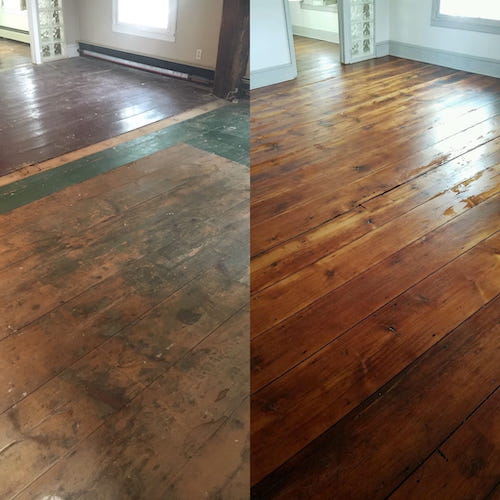
hardwood floor refinishing service before after

Cleanup & Final Prep

Once sanding’s done, we treat cleanup as part of the craft. Every wall, vent, and corner gets vacuumed twice. Then we go over the floor with tack cloths to pull the last trace of dust.

We patch nail holes or cracks using color-matched filler, hand-sand the spots flat, and do one last inspection under angled light. No swirl marks, no chatter – only smooth grain. When everything passes, we prep for finishing. That’s the moment clients start smiling – they can already see the transformation.

And if a homeowner ever started a job and called us halfway through, we finish it without judgment. Happens more often than you’d think.

Wrapping It Up the Right Way

Sanding floors isn’t glamorous, but it’s honest work. You hear the machines hum, smell the wood dust, see the grain return – that’s the reward. Every time we finish a job, there’s that second when sunlight hits the floor and it looks alive again. Smooth, clean, quiet underfoot. That’s when we know it’s right. So yeah – good floors aren’t rushed, they’re revealed. And if you’d rather skip the noise and the learning curve, that’s fine. Our pros at 1 DAY® Refinishing handle the full process start to finish – dust-free, clean, and steady.

Ready to see what your floors can look like? Contact us for a no-pressure quote – our crews handle everything from sanding to the final finish.